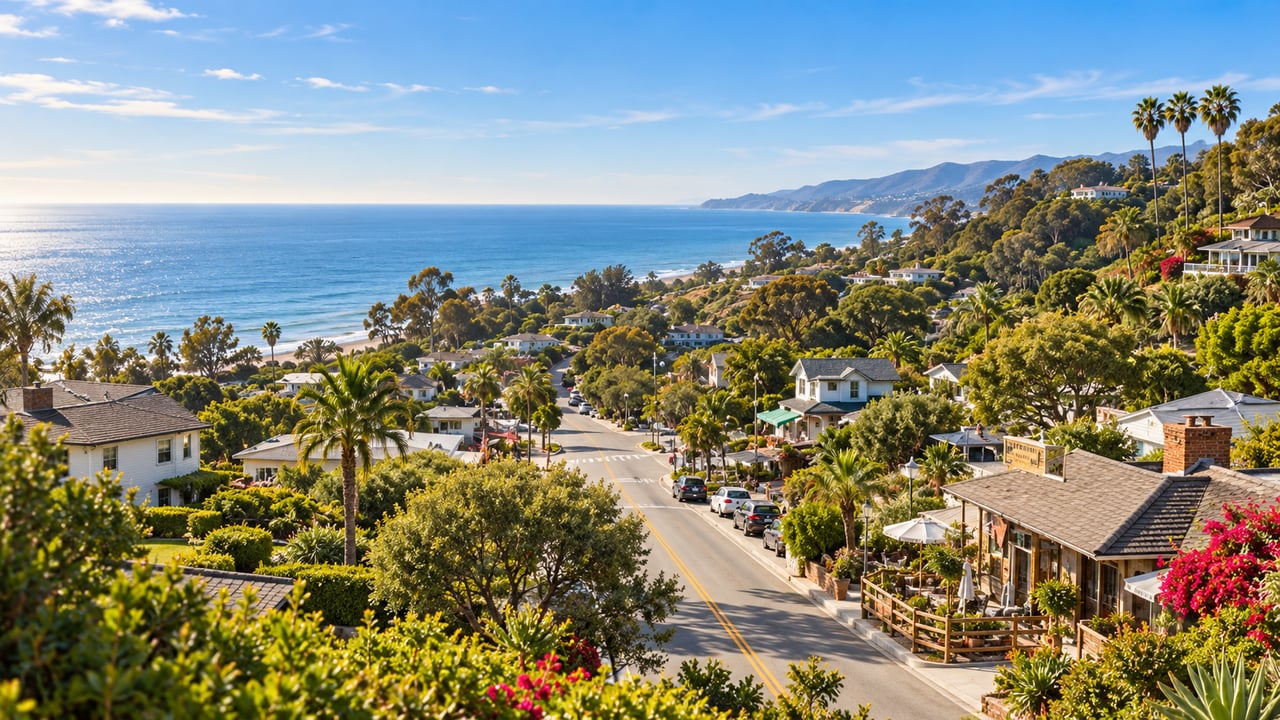
Pull Summerland numbers from three different sources this summer and they will not agree. One tracker puts the median sale price near $6.8 million for the three months ending June 2026, up sharply from the year before. Another, updated this summer, lists the typical home value under $2.6 million. A third shows a median list price above $12 million as of June 2026, with homes sitting on the market for well over 600 days. None of these numbers are wrong. They are measuring a village so small that a handful of closings in any given month can swing every headline figure on the page.
That is the first thing worth understanding about Summerland before an offer goes in. With single-digit monthly sales, an aggregate median tells you almost nothing about what a specific house is worth. What actually matters happens at the parcel level, and the most consequential parcel-level fact in this village has little to do with square footage or view corridor. It is whether the home you are buying, or selling, is connected to the Summerland Sanitary District's sewer system, and what that district's own uncertain future might mean for the infrastructure underneath it.
A Village-Sized Utility Carrying County-Sized Stakes
Summerland Sanitary District has served this community since 1957. According to the Santa Barbara County Local Agency Formation Commission, the district collects, treats, and disposes of wastewater for roughly 472 connections across the entire community, a customer base smaller than many single apartment complexes elsewhere on the South Coast. It runs its own treatment plant for one square mile of terraced hillside village between Montecito and Carpinteria.
Not every Summerland parcel is guaranteed to be tied into that system. Because the community is unincorporated and small, confirming whether a specific address is actually connected, rather than relying on a private septic system, belongs on the due-diligence list for any Summerland purchase, right alongside roof age and foundation condition. It is not the kind of fact a listing photo or a square-footage figure will surface for you.
The Fee That Doesn't Apply to a Simple Resale
Summerland Sanitary District currently assesses a capital recovery fee of $12,385 for a single-family home, with a proposal on the table to lower it to $11,946. It would be easy to assume this fee attaches to any sale. It does not.
Capital recovery fee (single-family home) | Current | Proposed |
|---|---|---|
Total fee | $12,385 | $11,946 |
Per the district's own published guidance, capital recovery fees are one-time charges paid by new development, and existing connections are not charged them except under specific circumstances: when a parcel is redeveloped or undergoes a significant change in sewer service intensity. A straightforward purchase of a home that is already connected and staying the same size typically does not reopen this fee. A substantial rebuild, an added unit, or a remodel that meaningfully increases plumbing fixture count can. For a buyer relocating from Los Angeles or the Bay Area with plans to renovate one of Summerland's small hillside cottages, that distinction is worth knowing before the architect's plans get too far along, not after.
Why the District's Own Future Is an Open Question
Summerland's sanitary district does not operate in isolation, and 2026 has been an unusually active year for the three utilities that share this stretch of coastline. The Montecito Water District, founded in 1921 and serving nearly 12,000 people across Montecito, Summerland, and Toro Canyon, has spent recent years pushing to consolidate with its two much smaller neighbors, the Montecito Sanitary District (founded 1947) and the Summerland Sanitary District (founded 1957), into one unified agency.
The timeline has not been smooth. On January 27, 2026, the water board approved a draft memorandum of understanding. On March 25, three of five Montecito Sanitary board members signaled support for moving forward, rebuffing a motion from board president Rock Rockenbach and director Carter Ohlmann to halt consolidation talks entirely. Then, on April 22, the MOU vote itself failed on a 2-2 tie, after board Vice President Dana Newquist resigned just two hours before the meeting, citing time constraints. He was the fourth director to leave that board in four years. As of that April reporting, Summerland's own board had not yet formally voted on the reorganization agreement its neighbors were negotiating. Business manager Diantha Glaser said at the time that sending Summerland's wastewater to a larger district could make sense, provided it serves the district's own customers rather than simply solving someone else's problem.
Part of the friction comes down to infrastructure condition. Rockenbach has described Montecito Sanitary's own treatment plant as "tied together by bailing wire and duct tape," which is part of why he and Ohlmann have argued the district should focus on fixing its pipes and deciding on a plant upgrade before entertaining a multi-year merger. That decision now rides on a $1.7 million engineering study comparing a rebuilt local plant against shipping Montecito's wastewater to the City of Santa Barbara for treatment, with results expected this fall. Separately, Montecito Sanitary approved its first rate study since 2016 in April 2026, opening a formal Proposition 218 public review process with a hearing held in June.
None of this means Summerland rates are about to spike, and no one involved is promising a merger will happen on any fixed timeline. Director Woody Barrett has estimated a consolidated agency would take at least three years to stand up even if all three boards agreed tomorrow. But it does mean the small utility responsible for wastewater service in this village is mid-negotiation over its own governance, sitting next to a neighboring plant with cracked foundations and an open question about where treatment happens in the future. That is context worth having in any conversation about long-term ownership costs here, even though it will never appear in a comparative market analysis pulled from the MLS.
If You're Selling
- Confirm in writing whether your parcel is connected to the sanitary district's system or relies on a private septic system, and keep that confirmation with your disclosure documents.
- If you've completed, or are planning, a remodel that meaningfully increases bedroom count or plumbing fixtures, ask the district directly whether a capital recovery fee applies before you're mid-escrow and a buyer's lender is asking the same question.
- Be ready to talk through the district consolidation story. A well-informed buyer researching Summerland will find the same local news coverage you did.
If You're Buying
- Request a direct connection confirmation from the sanitary district rather than assuming service status from the address alone.
- If your plans include a significant rebuild or addition, budget for the possibility of a capital recovery fee assessed at the permit stage, not at closing.
- Treat any portal-sourced median price as a loose signal only. With a handful of sales closing each month, the number reflects whichever few houses happened to transact, not a stable market trend.
A Short FAQ
Does buying an already-connected home in Summerland ever trigger a new sewer fee? Generally no. The capital recovery fee is structured for new development or for a parcel that is redeveloped or significantly changes its service intensity, not for a straightforward resale of a home already tied into the system.
Will Summerland definitely merge with Montecito's water and sanitary districts? Not yet, and not soon. As of the most recent public reporting this spring, Summerland's board had not formally voted on the reorganization agreement its neighbors were negotiating, and even proponents of consolidation estimate a unified agency would take years to establish.
If a property is on septic instead of the sanitary district's system, does any of this apply? The district fee and consolidation questions apply specifically to properties connected to the sanitary district's sewer system. A home on private septic shifts the relevant due diligence to septic inspection and maintenance history, a separate conversation worth having directly with your agent.
Summerland rewards buyers and sellers who look past the headline number and ask the parcel-specific questions this village actually requires. If you are weighing a purchase or a sale here and want a clear-eyed read on what a specific property's utility status and history mean for your plans, Live In Santa Barbara is glad to walk through it with you. Let's Connect.