Is Santa Barbara Real Estate a Good Investment?
People ask me this more than almost any other question. It comes from buyers sitting across from me at my office on Coast Village Road, from friends in the Santa Ynez Valley wondering if they should hold or sell, and lately from a lot of people relocating from Los Angeles who want to know if the move makes financial sense. My answer is always the same: it depends on what you mean by investment, and it depends on your time horizon. But for the right buyer, with the right expectations, the answer is generally yes.
Let me explain what I actually see in this market after more than three decades of living here.
The long view is the only view that matters
Santa Barbara real estate does not behave like Phoenix or Las Vegas. It does not spike wildly and then crash back to earth. What it does, over time, is grind steadily higher, occasionally with sharp bursts of appreciation, occasionally with flat or slightly declining years, but with a long-term trajectory that has consistently rewarded patient owners.
Over the 20 years through 2018, Santa Barbara home prices appreciated roughly 170%, ranking the market in the 93rd percentile nationally for that time frame. The decade that followed continued in the same direction. By the end of 2025, median prices for houses and planned unit developments on the South Coast reached a 35-year high, according to the Santa Barbara MLS, with year-to-date average and median pricing both at record levels. The South Coast median finished 2025 at approximately $2.33 million, up more than 8% from the year before.
Montecito, which has its own market dynamics, closed out 2025 with a median of $6.19 million, a 6.3% increase year-over-year, and a record 12 sales above $20 million. The year's top sale, 700 Picacho Lane, closed at $60 million.
These are not numbers conjured by hype. They reflect a market where supply is structurally constrained and demand comes from a global pool of buyers.
Why supply stays tight
This is the part that most outside analysis misses, and it is the most important factor in understanding why Santa Barbara appreciates differently than most California cities.
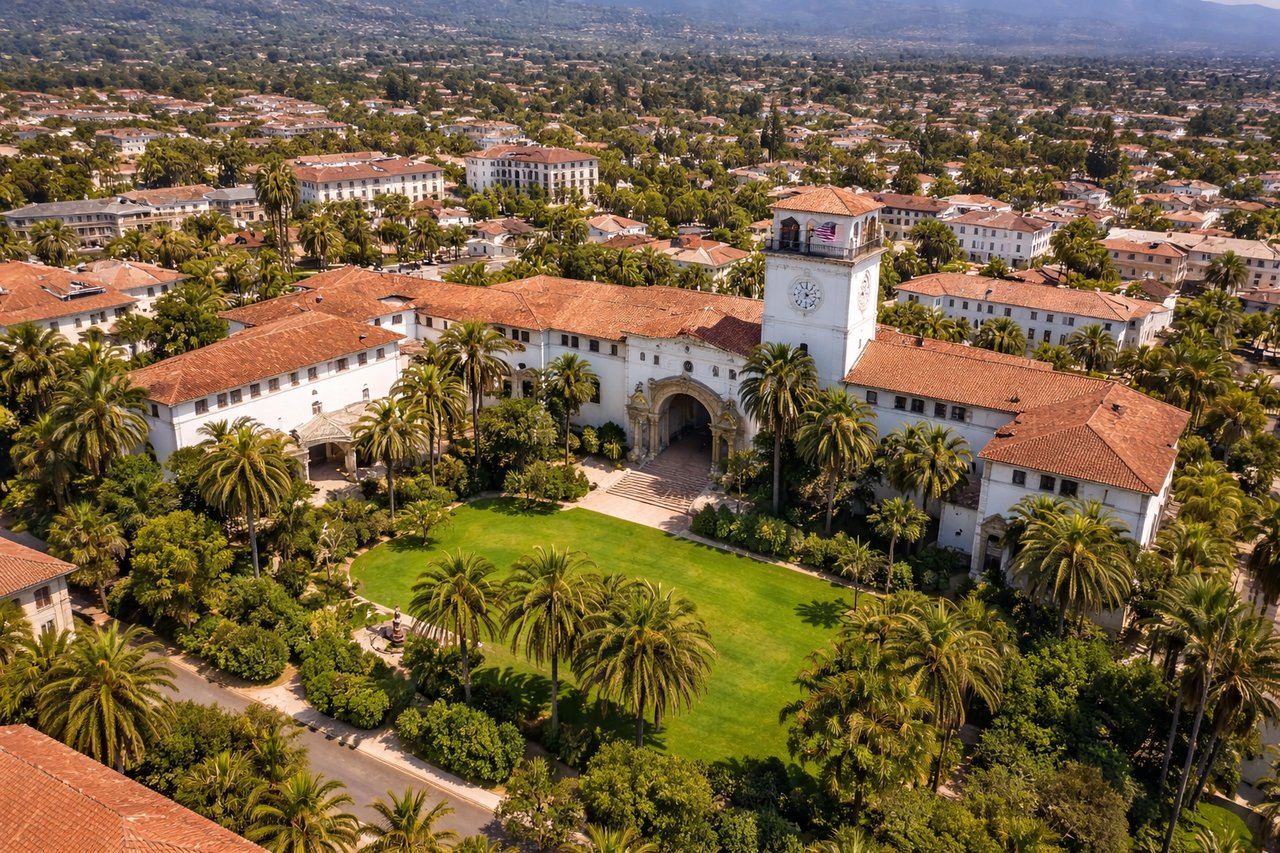
Santa Barbara is hemmed in. The Pacific Ocean runs along the south. The Santa Ynez Mountains run along the north. The city has been under a building height restriction since 1975 that keeps most of downtown and the neighborhoods near it to two stories. Zoning throughout the area is largely single-family residential with very limited opportunities for new density. The Spanish Colonial architectural standards, which are enforced by the city's Architectural Board of Review, add cost and time to any new construction or renovation.
The result is that new inventory enters the market at a trickle. At the end of 2025, there were only 216 properties for sale across the entire South Coast. Ten years ago, a typical month would have shown 400 or more available properties. The market has structurally tightened, and there is no realistic path to reversing that.
When demand is consistent and supply cannot grow to meet it, prices rise. This is not a mystery.
Who is buying, and why it matters
One of the most important indicators of long-term market health is the buyer pool. Santa Barbara's is unusually strong.
Approximately 35 to 38% of transactions in recent years have been all-cash, depending on the month. That means a significant portion of this market is insulated from interest rate cycles entirely. When rates spiked to 7% and nationally sales volume cratered, Santa Barbara's cash-buyer segment absorbed much of the demand that would have otherwise evaporated.
The buyers themselves come from across the country and increasingly from outside it. Executives, entrepreneurs, retirees, remote workers who decoupled from geography, and long-term visitors to the area who eventually decide to stay. The demographic replacement of buyers here is not dependent on local wage growth. It is driven by wealth mobility, and that is a structural tailwind that does not reverse easily.
Where the honest caveats are
I have been doing this long enough to know that real estate cheerleading does not help anyone make a good decision. So here is what I actually watch for.
Entry price matters enormously. At a median above $2.3 million, Santa Barbara is not an entry-level investment play. The carrying costs are real, the transaction costs are real, and if you need to sell inside two or three years, there is no guarantee you will come out ahead. This market rewards long holds. Buyers who have done best here are the ones who bought with the intention of staying, and either stayed or were pleasantly surprised by appreciation when life changed.
The insurance situation is a legitimate headwind right now. State Farm, Allstate, and several other major carriers have stopped writing new policies in California. The California FAIR Plan exists as a backstop, but it is more expensive and less comprehensive than a standard policy. This is a real cost that every buyer needs to underwrite carefully. It affects some neighborhoods more than others, including hillside properties, Riviera lots above the fire road, and certain areas in Montecito. I walk through this with every buyer before they make an offer.
Not every neighborhood appreciates equally. Goleta, with its proximity to UCSB and lower entry price points around $1.6 million for houses, has shown consistent demand from a different buyer profile than Montecito. The Mesa and Upper East tend to hold value well because of walkability and neighborhood character. Hope Ranch has a thinner market, sometimes 19 or more months of inventory, meaning individual sales can be more variable. Knowing which sub-market you are buying into matters as much as buying in Santa Barbara generally.
The question I actually ask buyers
When someone asks me whether Santa Barbara real estate is a good investment, I try to redirect the question slightly. The better question is: does this purchase make sense for your life, and can you hold it long enough for the market to do what it has historically done?
If you are buying a second home and plan to use it for 10 or more years, the data is strongly in your favor. If you are buying a primary residence and plan to be here for a decade or longer, you are entering a market with a demonstrated record of appreciation, limited downside relative to most California markets, and a structural supply constraint that shows no sign of easing.
If you need to be in and out in two years, or if you are counting on short-term appreciation to fund something else, this is not the market for that strategy. It never has been.
I have lived in Santa Barbara for over 33 years. I have watched the market absorb the 2008 crash, the 2020 pandemic, two major fires, and multiple interest rate cycles. Each time, the recovery has been real, and the long-term trajectory has resumed. That is not a guarantee of anything, but it is a pattern worth understanding.
If you want to talk through how the current market applies to your specific situation, I would love to connect. Reach me at [email protected] or (805) 455-7661, or browse current listings to get a sense of what is available right now.
Cammie Calcagno-Newell is a licensed California real estate agent and partner with C&H Real Estate Group, the number one team in the Santa Barbara MLS. She has lived in Santa Barbara for over 33 years and specializes in luxury residential real estate across Santa Barbara, Montecito, Hope Ranch, Carpinteria, and the surrounding communities.